

Players from the tradition
You already play Italian traditional music by ear and you want to understand what you are doing: build a technique without useless tension, read rhythm, place your repertoire inside a documented history.
Course in Mediterranean Traditional Music, Frame Drums specialisation · Conservatorio Statale di Musica “Saverio Arlia”, Nocera Terinese (CZ), Italy · Professor: Andrea Piccioni
The primordial beat: technique and rite on the skin.
In Italy you can study frame drums at a state conservatory. Not as a secondary instrument, not inside a folk-music workshop: as your principal instrument, with an academic curriculum.
The path has four levels — pre-AFAM, preparatory, three-year first level and two-year second level — so you can enter without yet holding the requirements for academic admission and build them along the way.
The course runs across the frame drums of the Mediterranean and their techniques: bendir, tar, riqq, the Italian tamburello in its traditional and modern forms, the tammorra, the idiophones that go with them, and Indian solkattu. The Italian tamburello is central, but the course does not end there.
It was established under my instrumental direction and gathers a lifetime of work on these instruments: research into the historical sources, the widening of technique, the encounter with Arabic and Indian rhythmic languages. Here that work becomes a structured course of study, with examinations and a degree.
The course is taught in Italian. International students need Italian at B1 level — see the questions below.
You already play Italian traditional music by ear and you want to understand what you are doing: build a technique without useless tension, read rhythm, place your repertoire inside a documented history.
You study or have studied classical percussion, drum kit or other membranophones, and you want to add a real specialisation, not a three-day seminar.
International students looking for the school of frame drums in the country the tamburello comes from. Several of my current students come from outside Italy.
The three-year level asks for no previous experience on frame drums: it asks for a good sense of rhythm and a willingness to question it.
The curriculum covers six areas.
The North African frame drum, played lap style. This is where the finger techniques come from on which the whole modern frame-drum school is built.
The large-diameter drum held vertically: posture, balance, sound production at the three points of the skin, dynamic range.
Traditional tamburello, modern tamburello, tammorra and tammorra without jingles. The heart of the course: the repertoires of Italian traditional music from north to south, and the contemporary technique born out of them.
The tambourine of Arabic classical music, with its own system of strokes, its rhythmic forms and the precision it demands.
Castanets, sgnacchere, jaw harp: the instruments that historically travel with frame drums and widen the player's range of timbre.
The rhythmic vocalisation of South India. Not an exotic addition: it is the most effective way I know of giving a name and a voice to what the hands do.
Pre-AFAM and preparatory levels. The two levels that come before the academic course: for players who want to start without yet meeting the requirements for admission to the three-year level, and for those arriving from a different training who need to build the ground on the instrument.
Three-year first level. Building technique, Italian traditional repertoires, first elements of riqq and solkattu, ensemble playing.
Two-year second level. Specialisation, contemporary repertoire, electronics applied to frame drums, personal research, dissertation.
Alongside the principal instrument, the curriculum includes the theoretical, historical and ensemble subjects common to every academic course at the Conservatory.
Lessons are not spread week by week. They are concentrated in four-day residencies, one every three weeks, synchronised across all the teachers of the Traditional Music area.
Each residency straddles the weekend — Friday and Saturday, then Monday and Tuesday — eight hours a day: thirty-two hours per residency. Over ten residencies, from November to July, that comes to 320 hours of face-to-face teaching. It is not a reduced course: it is the same hours, distributed differently.
For anyone coming from far away this is the whole difference. With weekly lessons you have to reach Nocera some thirty times a year; with residencies, ten, with longer stays and continuity of work. If you live hundreds of kilometres away — or in another country — that is the difference between a course you cannot do and one you can.
The individual instrument lesson and improvisation practice, ensemble playing and dance workshop, rehearsals, theory taught in compact form.
Masterclasses, and the trips out of the classroom: patronal feasts, seasonal rites, village festivals and night gatherings, meetings with the players who hold the repertoires. Oral transmission is completed by watching and playing where the music lives.
Guided individual study on the platform, video materials and tutorials, preparation for examinations.
Residency dates and examination sessions are published each year by the Conservatory.
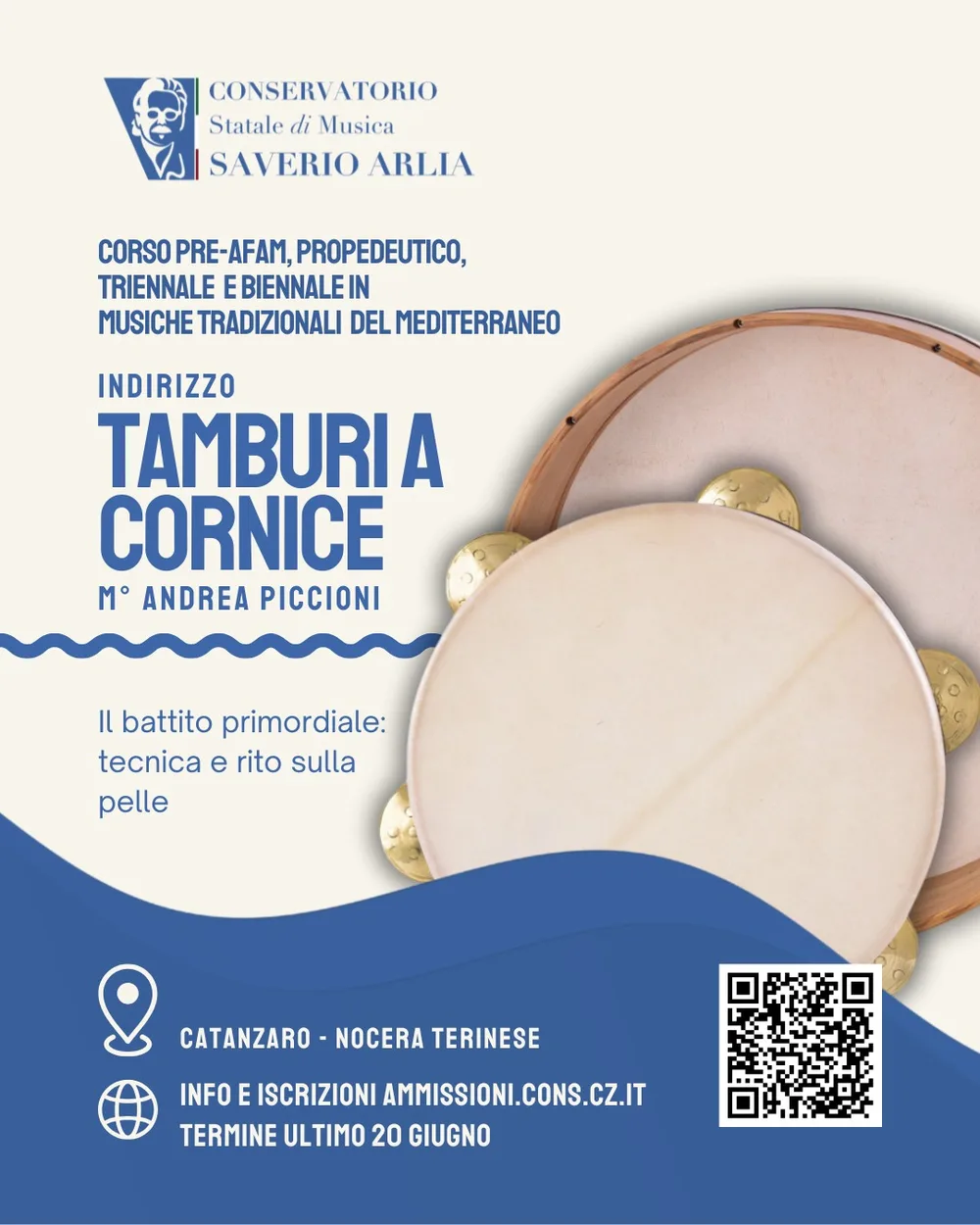
Applications go through the Conservatory portal, which publishes the admissions notice each year with the deadlines and the programme of the entrance examination.
For candidates without specific experience on frame drums, the examination assesses rhythmic sense, not a ready-made repertoire. International students are required to certify Italian at B1 level.
Applications: ammissioni.cons.cz.it — Conservatory portal: cons.cz.it — Student office: +39 0968 923854
No. The three-year level asks for a good sense of rhythm. Many students arrive from drum kit, classical percussion or other membranophones.
The three-year and two-year levels now award a full bachelor's and master's degree. In 2026 a decree replaced the wording “first and second level academic diploma” with “laurea” and “laurea magistrale”, aligning conservatory qualifications with university ones.
Yes, and students already do. You need Italian at B1 level together with the procedure set out for international students on the Conservatory portal. That procedure — pre-enrolment through the Universitaly portal, the study visa, the residence permit once you arrive — is handled by the Conservatory's registry office, which is the right place to write to for your own case.
Because the course is taught in Italian, and because the repertoires are oral: much of what is transmitted is transmitted in words, in the field, by people who do not speak English. B1 is enough to follow and to take part.
No. Lessons are concentrated in four-day residencies every three weeks: you come ten times a year, not every week. The nearest airport is Lamezia Terme, 28 km away, with 56 destinations in 18 countries; the Nocera–Savuto railway station is on the Tyrrhenian line.
No. The Italian tamburello is the centre, but the course covers the frame drums of the Mediterranean as a whole — bendir, tar, riqq — together with solkattu and idiophones.
The online courses are a technical path you follow on your own, with no examinations and no qualification. The academic course is a complete degree, with individual lessons, complementary subjects and a final diploma. Many students use the online courses to prepare for the entrance examination.
Questions about the path, the entrance examination or the curriculum? Write to me — in English is fine.